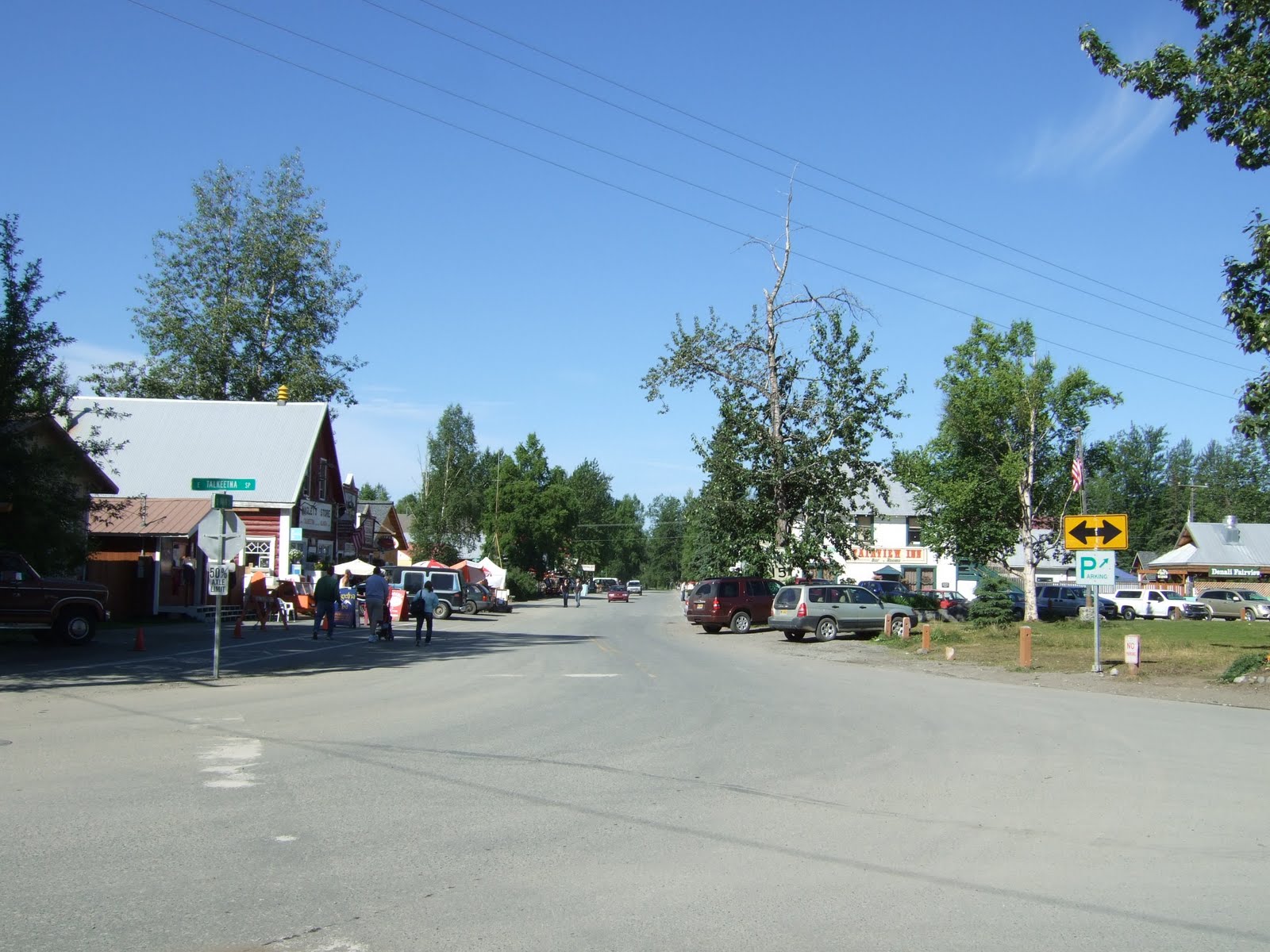
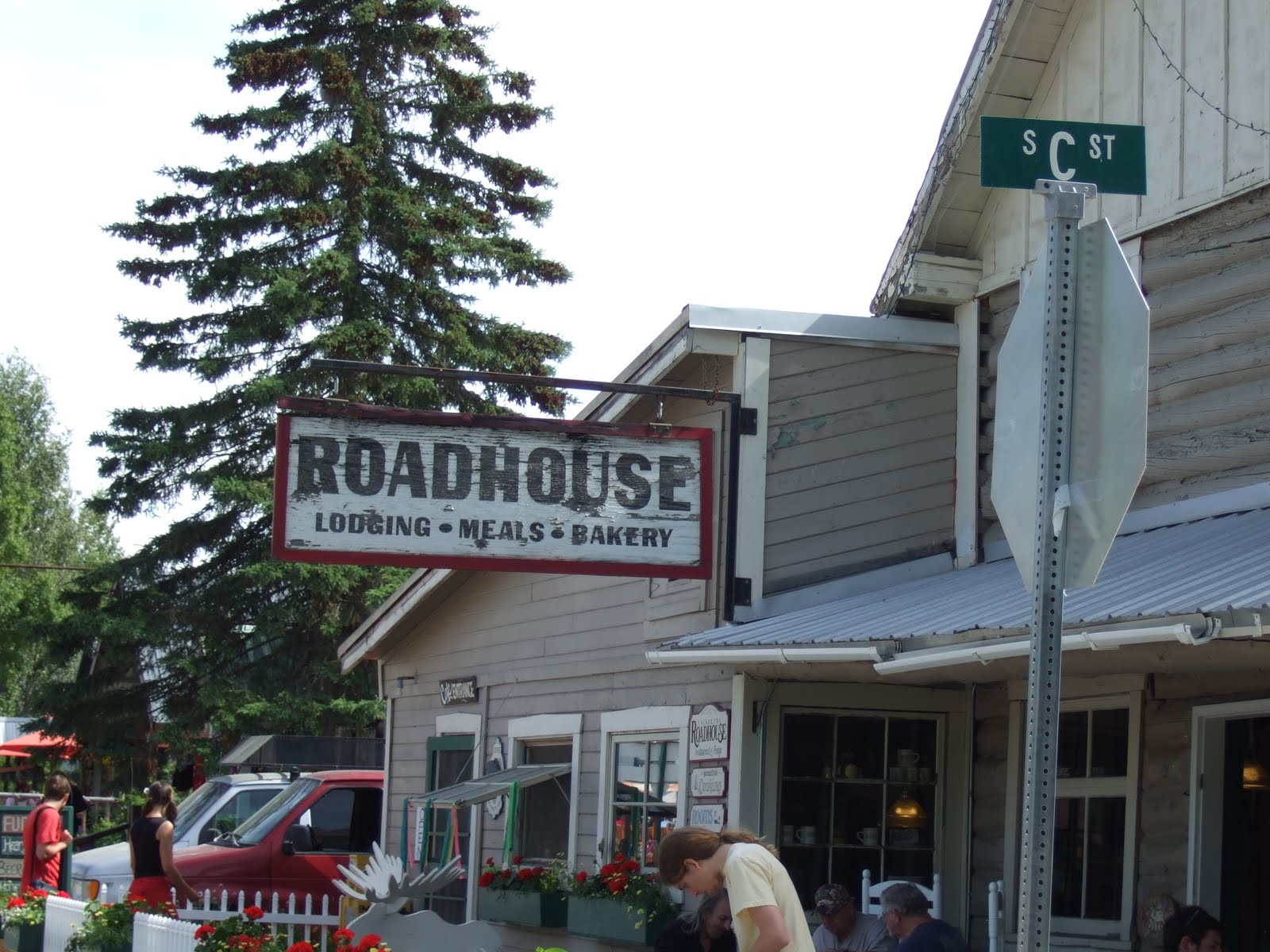
We left Seward and started the trek to Denali. We stopped for 2 days north of Willow at the Mat-Su Rv Park. This is a nice park with good wifi. The next day we went to Talkeetna a small little tourist town which can have great views of Mt. McKinley. We were very luck as the sky was very clear. We stopped at a turnout which gave us spectacular views of Mt. McKinley. There were a lot of people stopping and taking advantage of the clear view. After taking lots of pictures we drove on to Talkeetna a small town of 600. This town is the jumping-off point for most climbing expeditions to Mt. McKinley. Most climbers start at the Kahiltna Glacier at 7,200 ft and continue on to the summit of the South Peak at 20,320 ft. We saw a movie at the ranger station of climbing the mountain and it really is amazing that men and women tackle this mountain, the largest in North America. We enjoyed the town and had a great lunch at the Roadhouse. After lunch we went back to look at Mt. Mckinley but the clouds had blocked it's view. We were told that only 30% of the visitors actually get to see Mt. McKinley. But we were in the 30% and really enjoyed being able to see this masterpiece!!
On to Denali on Saturday:))
Saturday, July 16, 2011
Thursday, July 14, 2011
Our last 2 days in Seward
After our long day yesterday, Monday, we decided to relax and catch up on things. In the afternoon we took a drive around to the other side of Seward. We found a boat yard and the largest employer of Seward, the prison.
On Wednesday we were ready to tackle Mt. Marathon.
History of the race at Mt. Marathon:
Every 4th of July since 1908 there is a runners race that goes up Mt Marathon. The race begins downtown, on Fourth and Jefferson, in front of the First National Bank, and ends a block south of where it began, on Fourth and Adams. The halfway point is a stone marker[1] atop Mount Marathon, 3022 feet (921 m) above sea level, and a mile and a half from the finish line. The total race course distance is about 3.1 miles (5 kilometers). Leading racers will typically reach the peak from the starting line in 33–40 minutes, and reach the finish line from the peak in 10–15 minutes. Average speed uphill is 2 mph. Average speed downhill is 12 mph. It is not uncommon for the racers who finish to cross the finish line injured or bleeding and covered in mud.
Well we found the place where the runners start to climb the mountain but it was way too steep for Suzanne and I. So we headed over to where the jeep trail goes up the mountain. This trail is also steep and as before our Stress test was free. The climb is very steep for a long way and we were only going to a section where we left the runners trail and go to a waterfall that can be seen from the main highway in Seward. We made it to this junction and continued on for about a half mile until we got a little worried about BEARS. A decision was made and it was the correct one to go back to the truck. I forgot to mention when we started the trail we saw someone who had just come down from the trail and she said "do you have a gun or bear spray?" well we have neither. We made it back to the truck unharmed and still felt we had a good hike.
We went back to the waterfront, had lunch and watched through the binoculers as a few people were making it to the top. I can't even imagine trying to make that climb!
On to Willow, Alaska tomorrow.
On Wednesday we were ready to tackle Mt. Marathon.
History of the race at Mt. Marathon:
Every 4th of July since 1908 there is a runners race that goes up Mt Marathon. The race begins downtown, on Fourth and Jefferson, in front of the First National Bank, and ends a block south of where it began, on Fourth and Adams. The halfway point is a stone marker[1] atop Mount Marathon, 3022 feet (921 m) above sea level, and a mile and a half from the finish line. The total race course distance is about 3.1 miles (5 kilometers). Leading racers will typically reach the peak from the starting line in 33–40 minutes, and reach the finish line from the peak in 10–15 minutes. Average speed uphill is 2 mph. Average speed downhill is 12 mph. It is not uncommon for the racers who finish to cross the finish line injured or bleeding and covered in mud.
Well we found the place where the runners start to climb the mountain but it was way too steep for Suzanne and I. So we headed over to where the jeep trail goes up the mountain. This trail is also steep and as before our Stress test was free. The climb is very steep for a long way and we were only going to a section where we left the runners trail and go to a waterfall that can be seen from the main highway in Seward. We made it to this junction and continued on for about a half mile until we got a little worried about BEARS. A decision was made and it was the correct one to go back to the truck. I forgot to mention when we started the trail we saw someone who had just come down from the trail and she said "do you have a gun or bear spray?" well we have neither. We made it back to the truck unharmed and still felt we had a good hike.
We went back to the waterfront, had lunch and watched through the binoculers as a few people were making it to the top. I can't even imagine trying to make that climb!
On to Willow, Alaska tomorrow.
| where the runners enter the mountain |
| view from our hikes highest point |
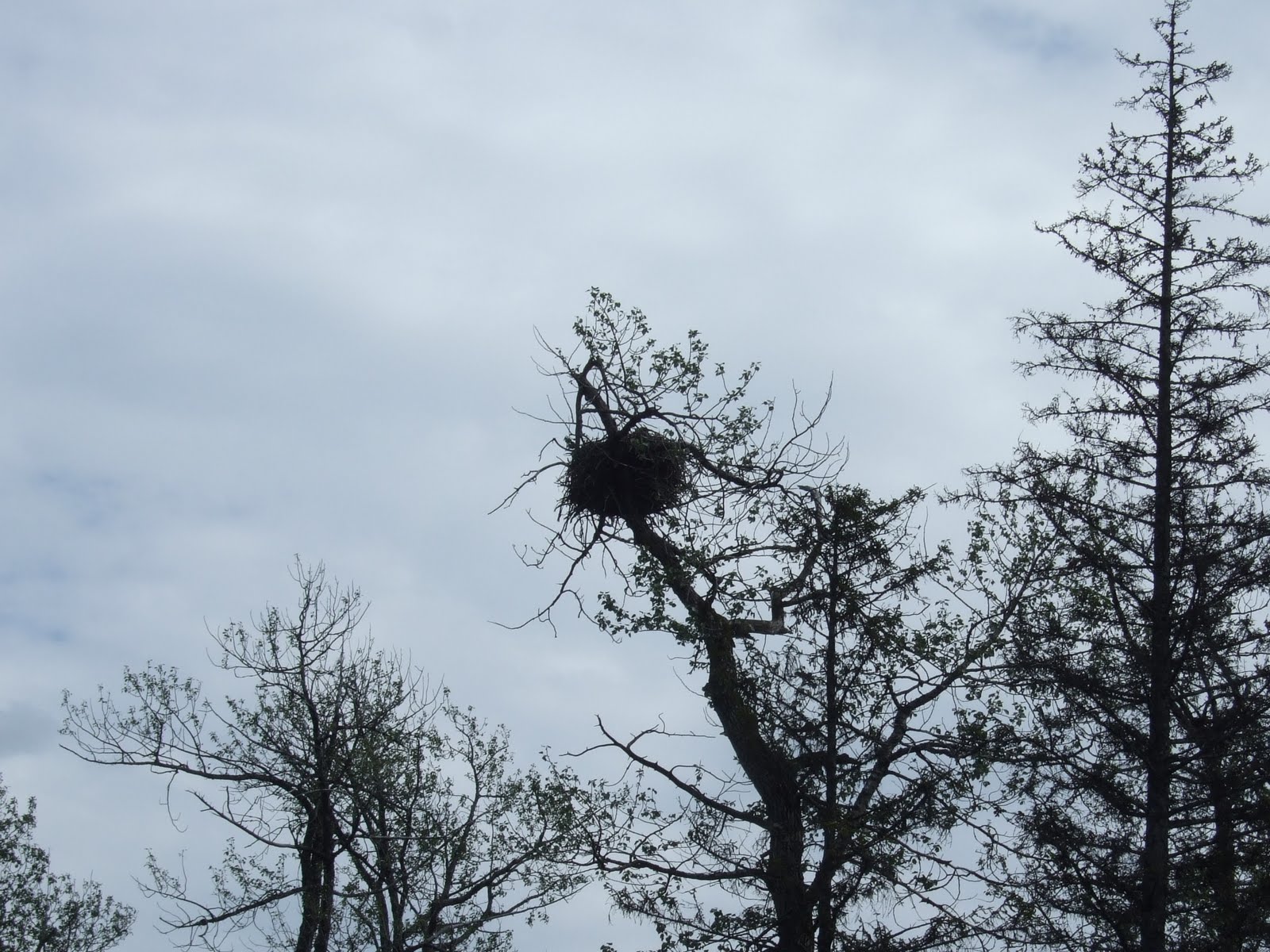
| Bald Eagles Nest |
Wednesday, July 13, 2011
Going on the Prince William Sound Cruise in Whittier
We had another cruise scheduled that would take us over to Whittier and Prince William Sound. The drive to Whittier was about an hour and a half and you have to leave a little earlier because there is a one lane tunnel to the town. You can only go through the tunnel to Whittier on the half hour. The tunnel is a little over 2 miles long through a mountain and is shared by all vehicles and a train. I have never seen or driven in a tunnel like this. We got to Whittier and it is a small port city with lots of fishing vessels and a few boats for daily cruises.
Some history on Whittier!
The city itself is a historical area, established by the U.S. Army during World War II. The Federal railroad to Portage was completed in 1943 and became the primary debarkation point for cargo, troops, and dependents of the Alaska Command.
In 1948 the military began construction of the first of two buildings for their military personnel as the Port of Whittier was then recognized as an ice-free, deepwater port strategically located to Anchorage and Interior Alaska. This remained active until 1960 at which time the total population was 1200.
The City of Whittier was incorporated in 1969. Today, less than 300 people reside in the town supporting the Alaska State Ferry, the Alaska Railroad, freight barge, commercial fishing, the Small Boat Harbor, recreation and tourism with an annual visiting population of over 700,000.
One of the two buildings was damaged by the tsunami caused by the earthquake in 1964. It is still standing because it has asbestos and would cost to much to remove. The remaining building was remodeled and now houses 80% of the city's population.
The cruise ship took us to several glaciers and we got really close and could hear the cracking and calving of the glaciers. We also got to see the harbor seals laying on the ice that had calved. All of the glaciers were of awesome proportions and one was 1700 feet high. This cruise was much smoother as the waters were protected by Prince William Sound. But once you get close to the glacier the weather changes and it becomes very, very cold! We also saw a humpback whale several times and its tail. They are really cool to see in the open waters. There were many sea otters just floating in the water. They just float on their backs and look so cute.
After getting off the vessel we had to wait to go throught the tunnel as you can only leave Whittier on the hour. Everyone lines up and heads back to their destination. We arrived home around 8:30 making it an 11 hour day, but worth every bit of time.
Some history on Whittier!
The city itself is a historical area, established by the U.S. Army during World War II. The Federal railroad to Portage was completed in 1943 and became the primary debarkation point for cargo, troops, and dependents of the Alaska Command.
In 1948 the military began construction of the first of two buildings for their military personnel as the Port of Whittier was then recognized as an ice-free, deepwater port strategically located to Anchorage and Interior Alaska. This remained active until 1960 at which time the total population was 1200.
The City of Whittier was incorporated in 1969. Today, less than 300 people reside in the town supporting the Alaska State Ferry, the Alaska Railroad, freight barge, commercial fishing, the Small Boat Harbor, recreation and tourism with an annual visiting population of over 700,000.
One of the two buildings was damaged by the tsunami caused by the earthquake in 1964. It is still standing because it has asbestos and would cost to much to remove. The remaining building was remodeled and now houses 80% of the city's population.
The cruise ship took us to several glaciers and we got really close and could hear the cracking and calving of the glaciers. We also got to see the harbor seals laying on the ice that had calved. All of the glaciers were of awesome proportions and one was 1700 feet high. This cruise was much smoother as the waters were protected by Prince William Sound. But once you get close to the glacier the weather changes and it becomes very, very cold! We also saw a humpback whale several times and its tail. They are really cool to see in the open waters. There were many sea otters just floating in the water. They just float on their backs and look so cute.
After getting off the vessel we had to wait to go throught the tunnel as you can only leave Whittier on the hour. Everyone lines up and heads back to their destination. We arrived home around 8:30 making it an 11 hour day, but worth every bit of time.
| the abandoned building |
| 80% of the residents live here |
Seward and the Alaska SeaLife Center
After the all day cruise yesterday we decided to take it easy today. We drove around town and did some shopping, a new jacket for me:) and visited the Alaska SeaLife Center. The center had sea lions and sea birds for you to get up close to. The facility also had a tank where you could feel the different marine life. It was amazing at how soft most of them felt.
Seward is a very neat port city where cruise ships come in. There are lots of tourists doing the tours of the gulf and many of them doing fishing charters. The silver salmon are running and we have seen some large catches being cleaned on the docks. We went to an area where we had seen bald eagles and were blessed to see what is called an immature eagle. They are beautiful creatures!!
Don't forget you can click on the pictures to enlarge them.
Seward is a very neat port city where cruise ships come in. There are lots of tourists doing the tours of the gulf and many of them doing fishing charters. The silver salmon are running and we have seen some large catches being cleaned on the docks. We went to an area where we had seen bald eagles and were blessed to see what is called an immature eagle. They are beautiful creatures!!
Don't forget you can click on the pictures to enlarge them.
Tuesday, July 12, 2011
The Kenai Fjords National Parks Cruise
We took the Kenai Fjords National Parks Cruise out of Seward on Saturday, July 9th. The weather was okay and when I say okay it means it is not raining. We really haven't seen much of the sun the whole time we have been here. The cruise leaves at 10 in the morning and you return at 5:30. They serve you lunch, which is all you can eat salmon and prime rib. Pretty good for a boat cruise! The cruise goes for 120 miles and has a National Park Ranger on the ship to narrate your adventure and to answer any of your questions. Leaving Seward you go thru Resurrection Bay going into the Gulf of Alaska. Once we hit the gulf the boat started to rock and numerous people became sea sick. We were glad, we had taken Bonine as neither of us had any trouble. We saw a family of Orca whales, harbor seals, humpback whales, Steller sea lions, sea otters, dall's porpoise that swim along the bow of the ship and many birds including the popular Puffins. The ship also took us to huge glaciers, Holgate and Aialik, which gave us some calving of the glaciers and some very loud cracking of the ice. Several times we thought it was thundering outside but it was the ice cracking. As we were near the glacier it was very cold and the wind kept you chilled to the bone.
I am sure there are days when you don't see all the different wildlife. Trying to get a picture of the whales is very difficult or should I say impossible:) But I tried without sucess.
This was a very enjoyable day and is a must do when in the area.
I am sure there are days when you don't see all the different wildlife. Trying to get a picture of the whales is very difficult or should I say impossible:) But I tried without sucess.
This was a very enjoyable day and is a must do when in the area.
Subscribe to:
Posts (Atom)